

On this day, Louis XIV’s secret second wife writes from Saint-Cyr to Mme des Ursins in Spain. Her longer letters are often written in more than one sitting. One passage in this letter was clearly written at the King’s favourite house:
“We have the Prince de Vaudémont at Marly…He seems to me to be very kind, but impotent. He is the darling of the court and everyone fights over him. The King gives him all kinds of good treatment, and he assures us that he will not leave Marly unless he is chased. Madame his wife has gone to take the Duchess of Mantua to Lorraine, where she is going to settle into a convent in Pont-à-Mousson. M and Mme de Vaudémont say that she was not safe in Italy and loudly praise her conduct there.
The King feels so well at Marly that he has extended his stay by 8 days, and we shall go from there to Trianon without passing by Versailles.”
Commentary:
Marly is the King’s escape from Versailles and Trianon; Saint-Cyr is his wife’s escape from all his houses. In this case, she seems to be taking a short break at Saint-Cyr before returning to Marly and then going on to Trianon with the King.
The Prince de Vaudémont is a younger son of the late Duke Charles IV of Lorraine and the uncle of the current (exiled) duke. He is 40 years old at this date. His wife is a cousin from the Elbeuf branch of the house of Lorraine, a branch long settled in France. They have taken refuge at the French court after being driven out of Milan, where the Prince had been the Spanish governor for many years before a combined Savoyard and Austrian army routed his forces.
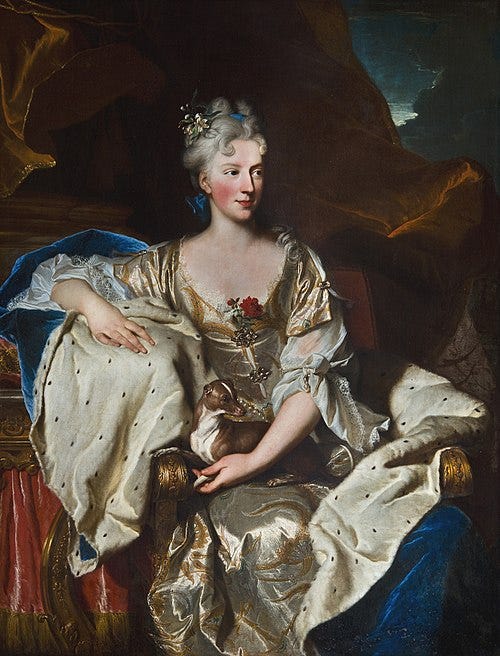
Pictured: Suzanne-Henriette de Lorraine (1686-1710), a daughter of the 3rd Duc d’Elbeuf and Duchess of Mantua as the consort of Charles III Ferdinand. Credit — Par Hyacinthe Rigaud — http://www.newportalri.org/items/show/13492, Domaine public, https://commons.wikimedia.org/w/index.php?curid=37848651
The Duchess of Mantua is a much younger half-sister of Mme de Vaudémont, born of their father’s third marriage. Mme de Vaudémont was born of the first marriage and is old enough to be her sister’s mother. The poor girl was married off at 18 years of age to the decades-older Duke of Mantua. When he appeared in Paris a few years ago to look for a wife, the Princess Palatine observed that he was remarkably ugly and an inveterate skirt chaser. Be that as it may, there were no children of the marriage and the couple separated in 1706, after which the duchess returned to France. Her now estranged husband will be the last Gonzaga duke of Mantua. Caught in the crossfire of the War of the Spanish Succession, the duchy has already been seized by the Austrians. Its independence is now lost forever. As for the dispossessed Duke, he will die in Venetian exile of natural causes in a little over a year.
The translation from the French is my own. Images that are not my own are in the public domain; I only explicitly credit them when the uploader has made it a condition of sharing his/her work via Wikimedia Commons. Words in italics in the body of the post or bold italics in verbatim translations and image captions are in the Glossary; the royal family and other Bourbons are in the Who’s Who guides; information about the sources is in the Bibliography; all of these are in the Resources section and freely available to paid subscribers and Grandes Entrées. If you have questions, please ask in the comments.